
How fast can you spot the difference between ‘sign up’ and ‘sign in’? Using these button labels together causes users to click the wrong button. But it’s not their fault. The mistake occurs because the labels are too similar.
This annoys users who sign in because they make the mistake the most. Signing in is a rote task that’s reinforced by repetition. Users shouldn’t have to always make a cognitive effort to distinguish the two buttons. It’s easy for them to get confused when both buttons use the same verb in their labels. This extra cognitive work they have to do creates a bad user experience.
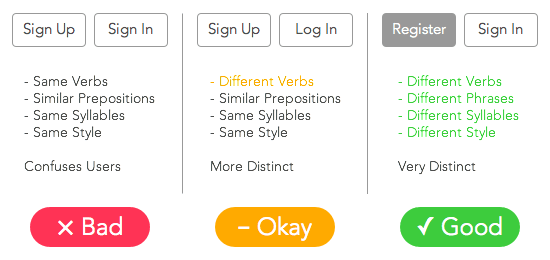
If you want to give users a faster login experience, avoid using ‘sign up’ and ‘sign in’ together. Instead, make the button labels distinct from each other by using different verbs.
There are alternative ways to say ‘sign up’ and ‘sign in’ that mean the same thing. A better way to say ‘sign in’ is ‘log in’. If you want to use ‘sign up’ as a button label, use ‘log in’ with it. The verbs are different and won’t cause confusion. But if you want to make your button labels more distinct than that, use a more specific label for ‘sign up’.
Some specific ways to say ‘sign up’ are:
- Register
- Join [Name of your site]
- Create Account
- Get Started
- Subscribe
The verbs in ‘sign up’ and ‘log in’ are different. But the prepositions are similar and the syllables are the same. This can still cause confusion among users. By making ‘sign up’ more specific, you remove the preposition and change the syllables. This gives your button labels a different cadence and makes it even more clear to users.
Text labels aren’t the only way to make buttons distinct. To help users click the right button every time, give your buttons a different visual style as well. It’s important for users to find your ‘sign up’ when they first visit your site. You should give that button a high-contrast color that stands out from the background. The ‘sign in’ button should have a color that blends in with the background.
When the labels of your ‘sign up’ and ‘sign in’ buttons are distinct, users will make less mistakes. They won’t have to exert cognitive effort to distinguish between two similar buttons. Instead of clicking the wrong button, they’ll click the one that leads them to the result they expect.
Book

Affiliate

Or instead of Create an Account you could consider ‘Join Now’…
Another great alternative!
So true. I am French and I always have to pause and think before clicking Sign In or Sign Up.
On my website http://taskarmy.com I use “Register” and “Log in” which are equivalent to what you are suggesting.
Thanks!
Great post as usual.
What about “Log In” vs “Login”?
Although Login is not a real word, it’s twice more used in the web and also Facebook uses it. So users are more likely to understand it.
I feel as though “log in” is a verb whereas “login” is a noun. Consider the following examples:
“Use the form below to log in to your account”
vs.
“Please provide us with your login and password”
Thoughts?
You are correct. ‘Login’ is a noun and ‘Log In’ is a verb.
Good point here — just off the top of my head, http://twitter.com/ does a good job of using the same terminology, but visually differentiating them well. They also do a good job of describing the instances as being wholly separate.
“Log in” is essentially a verb, while “login” is a noun.
This.
I use, Login and Sign up. Lots of sites use this, such as Facebook.
Login is fine if used to describe the text box where the user’s login information goes.
If it’s used to describe the action a user must take to log in, which is what Facebook does with their Login button, it’s wrong.
You cannot conjugate “login”. Do you say, “Hold on a sec; I’m logining.”? Sounds very unnatural to my ear. Thus, “Hold on a sec; I’m logging in.”
nicely written, simple to the point comparison, thank you!
Lydia Chicles
@BoldTechTv
Username [______________]
Password [______________]
(create account) (log in)
I like the idea of merging the two.
Doesn’t “Both prepositions begin with a vowel” apply to all three examples?
“Account” is a noun, not a preposition…
Incredible how little things like that can make a difference. I would vote for “Log in” and “Create Account”. You only create an account once, so I wouldn’t put that first.
Excellent article, Jordan. This is detail that most designers overlook. Some possible wordings to avoid what the article describes:
**Create a new account wording:
-Create an account
-Create account
-Register
-New user?
-Sign up
-Join us!
-Become a member
**Existing users:
-Member login (never used in combo with Sign up”)
-Log in (never used in combo with “Sign up”
-Members
-Member access
-Members only
I agree that LOGIN is a noun, while LOG IN is an action.
Well done, totally agree with you. Even for web developer like me sometimes it is hard to recognize proper link name. Haven’t seen many of sign-in sign-up examples on the web but probably there are some.
I use “Register” and “Login” for these cases. Names of operations you do like many things in computer world.
There are more than plenty of ‘Sign Up/Sign In’ examples on the web.
http://www.yahoo.com/
http://www.latimes.com/
http://www.codecademy.com/
https://www.goodreads.com/
http://carbonmade.com/
http://www.magcloud.com/
Huh, I never thought of this. I guess it’s most convenient for those who don’t speak English as their primary language. But differentiating the two links like the third example really makes it obvious as to which link the visitor is meaning to click on. Great post!
I really like the background color of your webstation page. I think you should be encouraged, so keep up the good work. I think you are doing a good job helping people unfamiliar with computers like yourself to share their experiences and ideas.
This article is very short sighted.
Copy, like many other things, should never be considered on their own!
http://carbonmade.com/ proves this perfectly, the sign up is a large call to action, while the sign in is a more neutral less visible item, with out copy surrounding them. Users revisiting will know where to look. New users will almost definitely notice the sign up first.
The grand scheme is very important!
Mark,
You’re right, but very few sites employ this effective use of CONTRAST to distinguish between Sign Ups and Sign Ins.
John
In our site in spanish we use Regístrate = Sign up and Accede a tu cuenta = Log in
Igra, you’re right ! I feel better! English is not my first language ,I thought I was the only one to be confused between ‘log in’ and ‘sign in’.
Register / Login …. That works for me.
I totally agree and even more when you are a foreign user and english is not your first language. I usually prefer “Log In” to enter and “Register” or a similar word to fill the form and make a new account.
Amazing article, but why don´t you have a Facebook LIKE button? I wanna like it! Sharing takes one more step and is pain in the ass.
Also where is “Subscribe to Comments” checkbox? I wanna be part of discussion, but why do you make it so tough to me?
Cheers,
We use
Sign In | Register
Already registered users can then invite other users which automatically register them so they can sign in straight away.
I like the idea of just entering your user name and password and the system simply registering you if you’ve not done so already or logging you in. Usability nightmare though!
Adding some text below in order to make it clearer, I think.
Something like :
[Sign in] [Sign up]
Does the existence of facebook/ twitter connect in some websites affects the chosen phrase, I think Log in is majorly used in those websites support the Fb/ twitter connect, or its just a coincidence ?
As a non native english speaker, this is one of the worst thing to deal with everyday on website. It amaze me that website like github.com have again this kind of label.
Maybe the user should have to differentiate between “sign up” and “sign in”. Chances are with whatever they’re doing the extra cognitive effort could save a little bit of that brain they’re planning on wasting on the next season of friends.
We discussed the sign up and sign in process so many times, as we have new restaurants registration, registered restaurants log in and employees of these restaurants log in as well.
At the end we agreed on our website https://instalacarte.com to keep only two buttons – Register for FREE and Log In, I hope it would work well and will not confuse three groups of clients
Thank you for the great post 🙂
The term “Register” I think has some overlap with organized events. If you also host events, consider being more descriptive about what you are registering for, or change the wording around. Obviously, only do this where it makes sense and there is room to do so. For example, you don’t want a “Register” event registration on the same page as a “Register” for account creation.